Separate the shooter from its projectile
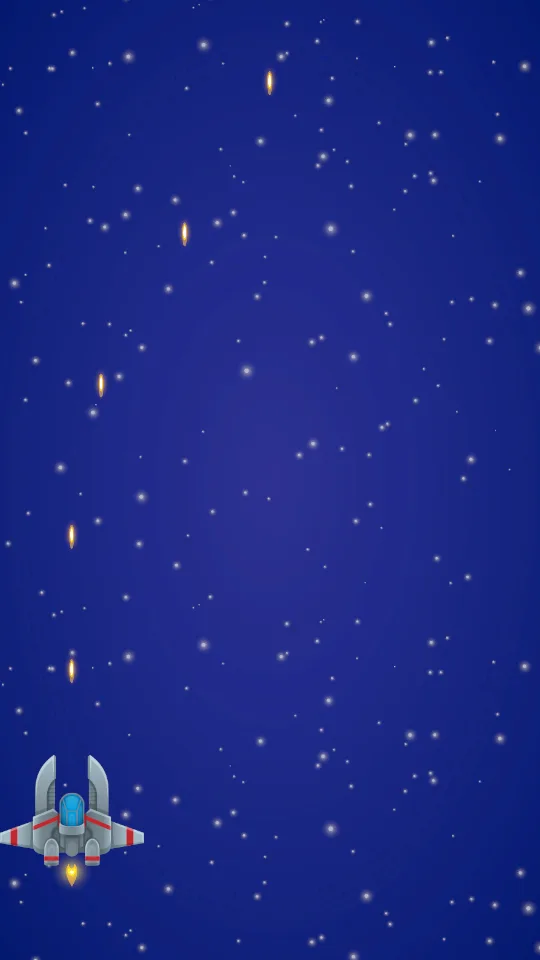
Start with the movable ship and save the scene as SEU_03_Shoot. Finish with held Space firing bullets that travel upward and disappear. There are no enemies yet, so damage is outside this lesson.
PlayerShooting decides when and where to create a bullet. Projectile decides how that bullet moves and expires. Existing bullets remain independent when the ship moves or stops firing.
A prefab is a template stored in Project; an instance is a copy in the scene. Save one prefab to create many bullets with the same renderer and behavior.
Make one projectile work first
Create Scripts/Combat/Projectile.cs:
Assets/_ShootEmUp/Scripts/Combat/Projectile.cs
using UnityEngine;

namespace ShootEmUp.Combat
{
    [RequireComponent(typeof(Rigidbody2D))]
    public sealed class Projectile : MonoBehaviour
    {
        [Tooltip("World units per second.")]
        [SerializeField] private float speed = 14f;

        [Tooltip("Seconds before the projectile removes itself, even if it hit nothing. Keeps the scene from filling up.")]
        [SerializeField] private float lifetime = 2f;

        private Rigidbody2D body;

        private void Awake()
        {
            body = GetComponent<Rigidbody2D>();
        }

        private void OnEnable()
        {
            Destroy(gameObject, lifetime);
        }

        private void FixedUpdate()
        {
            body.MovePosition(body.position + (Vector2)transform.up * (speed * Time.fixedDeltaTime));
        }
    }
}
Awake caches the Rigidbody. OnEnable schedules the lifetime. FixedUpdate moves along transform.up, the bullet's local Y axis, independently of the ship's subsequent position.
This is a create/destroy lifetime. Lesson 4 replaces the Destroy schedule with pool release. Merely switching Instantiate to pooling while retaining delayed Destroy would eventually delete a reused bullet.
Create an empty Bullet_Player, add SpriteRenderer, choose a laser sprite, and use Sorting Projectiles. Scale it smaller than the ship. Add Projectile, then configure Rigidbody2D as Kinematic, Interpolate. Set Speed 14 and Lifetime 2. Drag the object into Prefabs to create the template.
Play with one instance at the screen center. It should travel and disappear after about two seconds. Stop, delete the scene instance, and keep the prefab asset.
Muzzle is a position you can edit visually
Add an empty child named Muzzle to Player, approximately local position (0, 1.05, 0), local rotation 0. Put it at the ship's nose; adapt it to the artwork instead of treating 1.05 as universal.
It needs no renderer or collider. PlayerShooting reads its Transform. When changing ships, move the Muzzle without editing a hard-coded position offset.
Fire represents held input
Open ShmupControls and add Fire under Gameplay, Action Type Button. Bind Space, left mouse button, and gamepad buttonSouth. Save Asset.
Create Scripts/Player/PlayerShooting.cs:
Assets/_ShootEmUp/Scripts/Player/PlayerShooting.cs
using UnityEngine;
using UnityEngine.InputSystem;

namespace ShootEmUp.Player
{
    public sealed class PlayerShooting : MonoBehaviour
    {
        [Tooltip("Input Actions asset that contains the Gameplay/Fire action.")]
        [SerializeField] private InputActionAsset controls;

        [Tooltip("Prefab spawned for every shot. Its 'up' must point in the travel direction.")]
        [SerializeField] private GameObject projectilePrefab;

        [Tooltip("Where the projectile appears. A child Transform at the ship's nose.")]
        [SerializeField] private Transform muzzle;

        [Tooltip("Fire rate while the button is held.")]
        [SerializeField] private float shotsPerSecond = 6f;

        private InputAction fireAction;
        private float nextShotTime;

        private void Awake()
        {
            fireAction = controls.FindAction("Gameplay/Fire", throwIfNotFound: true);
        }

        private void OnEnable()
        {
            fireAction.Enable();
        }

        private void OnDisable()
        {
            fireAction.Disable();
        }

        private void Update()
        {
            if (!fireAction.IsPressed() || Time.time < nextShotTime)
            {
                return;
            }

            Instantiate(projectilePrefab, muzzle.position, muzzle.rotation);
            nextShotTime = Time.time + 1f / shotsPerSecond;
        }
    }
}
IsPressed means held, not newly pressed this frame. nextShotTime records the earliest allowed next shot. At six shots per second, the target gap is 1/6 ≈ 0.167 seconds.
t = 0 · Fire immediately if held
0 < t < 0.167 · Wait even while held
t ≥ 0.167 · Fire on the next eligible frame
Time-based cooldown avoids specifying a fixed number of frames. This simple implementation is still frame-quantized: low FPS can reduce the actual rate. It does not guarantee exactly six shots each second on every machine.
Connect three references with different roles
Add PlayerShooting to Player:
| Field | Drag from | Value |
|---|---|---|
| Controls | Project | ShmupControls |
| Projectile Prefab | Project | Bullet_Player.prefab |
| Muzzle | Hierarchy | Player/Muzzle |
| Shots Per Second | Inspector | 6 |
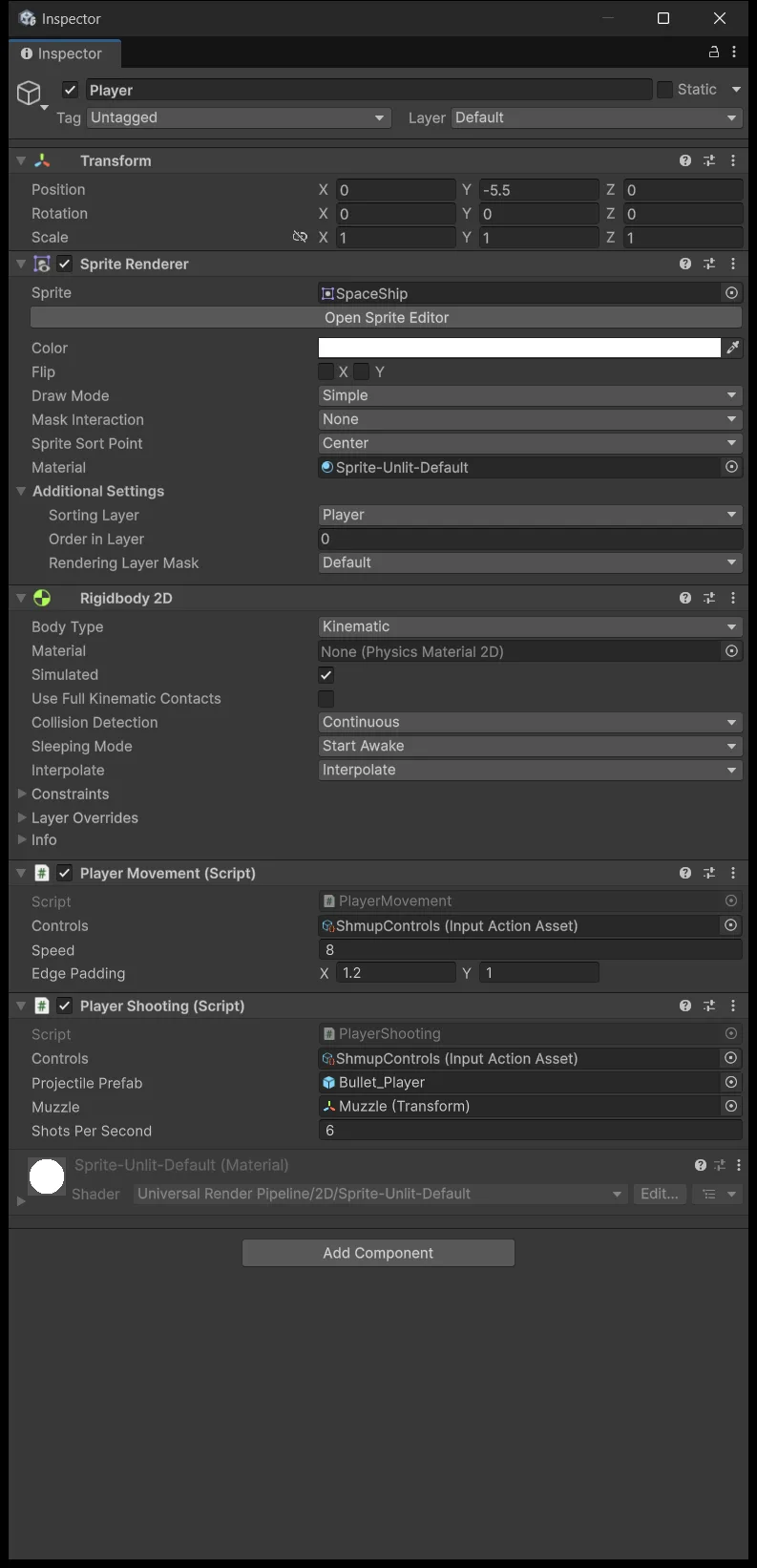
The prefab is an asset; Muzzle is a scene object. Confusing them commonly causes an incorrect firing position or an unassigned field.
Observe both firing and stopping
Play, hold Fire, and move. Bullets should spawn at the nose at firing time and then travel independently. Release Fire: no new bullets should appear, but old ones keep moving. After more than Lifetime, all should be gone.
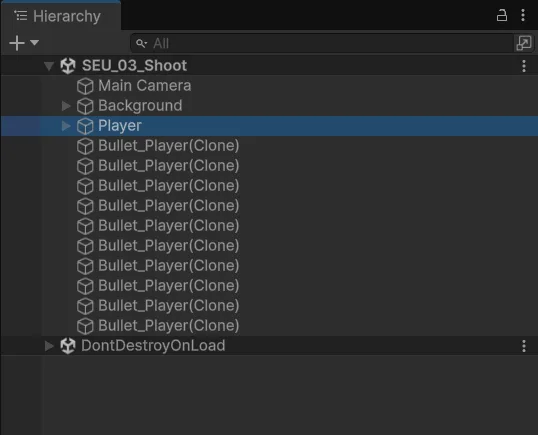
Estimated concurrent bullets equal actual firing rate multiplied by Lifetime: approximately 12 here. This is an estimate, not a condition that must hold on every frame.
Frequent creation and destruction alone do not prove the game stutters. Lesson 4 changes the lifetime mechanism and explains how to compare the same workload in the Profiler.
Source for this stage
Download all lesson 3 scripts. The archive contains code and assembly definitions, not scenes, prefabs, or the pictured artwork. Assemble the scene using this lesson. When upgrading, replace files at the same paths; never put two versions of a class in Assets.
Next: Shmup #4.